
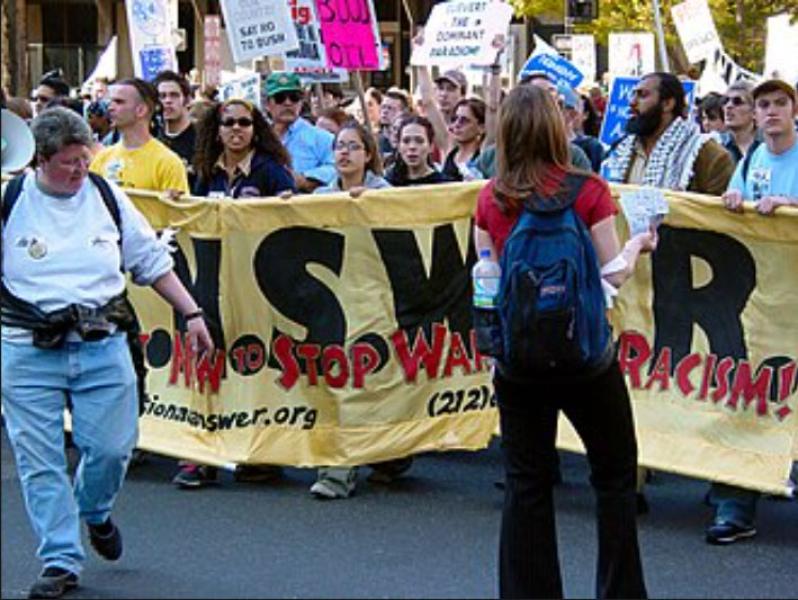
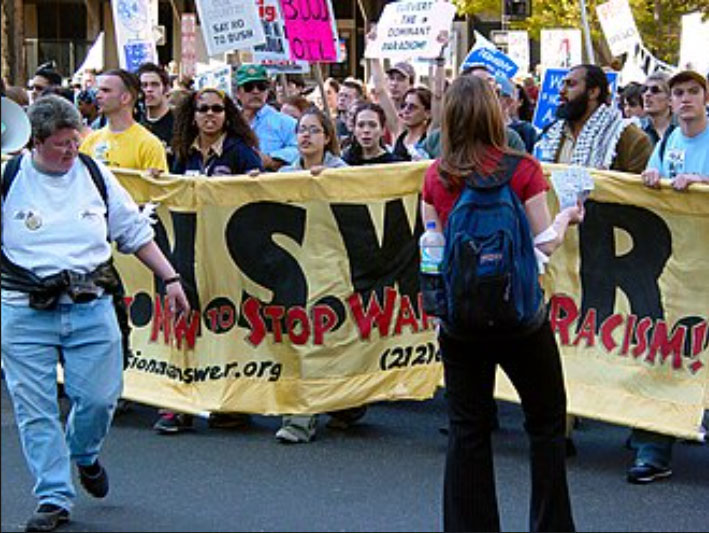
The years following September 11, 2001 produced one of the largest antiwar mobilizations in modern United States history. Millions of people entered the peace movement during the invasions of Afghanistan and Iraq, joining coalitions that brought together religious organizations, labor activists, students, veterans, military families, civil rights advocates, educators, and community organizers. Yet beneath the appearance of unity existed profound disagreements about strategy, leadership, political analysis, and movement priorities. Among the most prominent organizations shaping this era was A.N.S.W.E.R. (Act Now to Stop War and End Racism), whose influence on national antiwar mobilizations was considerable, but whose approach often generated tension with groups pursuing different visions of peace organizing.
Many organizations that would later become associated with the National Network Opposing the Militarization of Youth (NNOMY) emerged from a distinct tradition of activism. Their primary concern was not merely ending a specific war. Instead, they focused on the infrastructure that made future wars possible. Military recruitment in public schools, JROTC expansion, unequal targeting of working-class communities, poverty-driven enlistment, and the absence of nonmilitary career alternatives became central areas of work. For these activists, peace was not simply the absence of war overseas. It required sustained intervention in the institutions that connected American youth to the military system at home.
This difference in focus frequently created friction with organizations whose central priority was national mobilization. A.N.S.W.E.R. became known for organizing large demonstrations in Washington, D.C., New York, San Francisco, and Los Angeles. The coalition excelled at bringing hundreds of thousands of people into the streets and framing opposition to war within a broader critique of racism, imperialism, and economic injustice. From its perspective, stopping wars required confronting the political and economic systems that generated them. Mass protest was therefore not simply a symbolic act but an essential means of building public resistance.
Counter-recruitment organizations often viewed the situation differently. While many activists participated in A.N.S.W.E.R. demonstrations, they increasingly questioned whether periodic national marches were producing lasting institutional change. Local organizers working in schools encountered challenges that could not be solved by a weekend protest in the nation's capital. Recruiters continued to maintain offices near high schools. The military continued to obtain student information through federal policies. Budget cuts continued to remove civilian opportunities while military service was promoted as a pathway to education and employment. Organizers engaged in these struggles frequently felt that the painstaking work of community education received less attention than large national mobilizations.
The resulting tensions reflected two contrasting theories of social change. A.N.S.W.E.R. generally emphasized building a broad anti-imperialist movement capable of challenging national policy through visible public confrontation. Many groups within NNOMY's eventual network emphasized long-term local organizing that could reduce the military's influence over young people's lives regardless of which administration occupied the White House. One strategy sought to mobilize large numbers of people for immediate political impact. The other sought to build durable institutions capable of creating cultural and structural alternatives to militarization.
These differences became particularly visible on college campuses. The Campus Antiwar Network (CAN), one of the most significant student antiwar formations of the period, often found itself navigating relationships with larger national coalitions. Student organizers were eager to mobilize against the Iraq War but also wanted autonomy in setting priorities. Some activists feared that national organizations viewed campuses primarily as sources of turnout for demonstrations rather than as sites of independent political development. Debates arose over who should set agendas, how campaigns should be coordinated, and whether student activism should serve broader coalition strategies or maintain its own organizational identity.
Another recurring source of conflict involved messaging. A.N.S.W.E.R. consistently connected war to issues of racism, colonialism, economic exploitation, and global power. Many activists within the counter-recruitment movement agreed with these analyses but worried about how such frameworks translated in local communities. Organizers working with parents, teachers, guidance counselors, and students often developed messages centered on educational equity, youth opportunities, informed consent, and democratic rights. Their concern was practical as much as ideological. They believed that campaigns against military recruitment could attract a wider range of participants when framed around local impacts rather than comprehensive geopolitical critiques.
The distinction was not always a matter of disagreement over values. Frequently it reflected different organizing environments. A national antiwar coalition addressing hundreds of thousands of demonstrators faced different pressures than a local organization attempting to persuade a school board to regulate recruiter access. What sounded radical and mobilizing on a protest stage might sound alienating in a parent-teacher meeting. Consequently, some counter-recruitment activists viewed national coalitions as insufficiently attentive to the realities of grassroots organizing, while coalition leaders sometimes viewed local campaigns as too narrow in scope.
The question of coalition governance generated additional strain. Throughout the early 2000s antiwar movement, disputes repeatedly emerged over leadership structures and decision-making processes. Organizations committed to decentralized models often clashed with groups perceived as exercising stronger centralized direction. While such conflicts were hardly unique to A.N.S.W.E.R., the coalition's prominence ensured that debates surrounding its influence became highly visible. Critics occasionally argued that broad coalitions should function as democratic forums in which multiple organizations shared authority equally. Supporters of A.N.S.W.E.R. countered that effective mobilization required clear leadership, disciplined coordination, and coherent political messaging.
For many activists involved in anti-militarization work, these organizational questions had practical consequences. Counter-recruitment campaigns depended on local relationships built over months or years. Success required trust among teachers, students, veterans, religious communities, and local activists. A movement culture emphasizing local autonomy often appeared more compatible with those goals than one centered on national demonstrations. As a result, some organizations within the NNOMY orbit maintained cooperative relationships with A.N.S.W.E.R. while simultaneously preserving considerable independence from its political and organizational framework.
Despite these tensions, it would be misleading to portray the relationship solely through the lens of conflict. Members of A.N.S.W.E.R., student antiwar organizations, veterans' groups, peace educators, and counter-recruitment activists frequently stood together at rallies, conferences, teach-ins, and public forums. They opposed many of the same wars, challenged many of the same policies, and often defended one another against political attacks. The disagreements that emerged were not signs of separate movements but evidence of an unusually diverse coalition attempting to define its priorities during a period of national crisis.
In retrospect, the debates reveal an enduring question for peace activism. Should movements focus on mobilizing massive public opposition to ongoing wars, or should they devote greater energy to dismantling the institutions that prepare future generations for military participation? A.N.S.W.E.R. generally answered the first question by emphasizing national resistance to imperial war. Many of the organizations that became part of NNOMY answered the second by concentrating on youth militarization, educational justice, and community-based alternatives.
The historical significance of these differences lies not in who was right or wrong but in how each perspective illuminated a different aspect of militarism. National coalitions exposed the global consequences of war. Counter-recruitment organizations exposed the local systems that sustained it. Together they represented two distinct traditions within the broader peace movement, traditions that often cooperated, occasionally collided, and collectively shaped antiwar activism during one of the most consequential periods of American political dissent in the twenty-first century.
###