
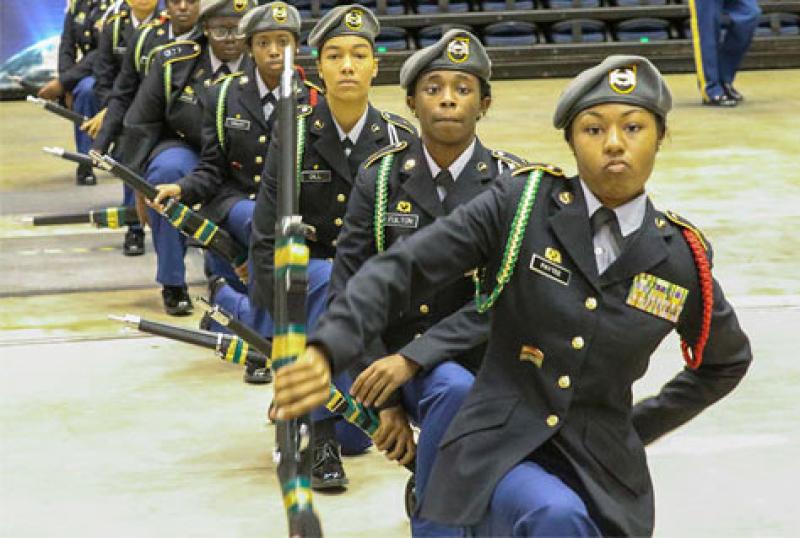
In under‑resourced schools, JROTC is not a choice — it is an institution
image source
Across the United States, young people encounter military culture in very different ways. Some meet it in school, where JROTC is woven into the daily routine of classes, hallways, and assemblies. Others join the Young Marines, a community program that families choose because they already feel connected to Marine Corps identity. These two pathways look similar on the surface — uniforms, ranks, discipline — but they reach different communities, shape different identities, and reflect deep inequalities in how military influence spreads across the country. JROTC grows in schools serving Black and Latino youth. Young Marines grows in white suburban communities. Understanding why helps us understand how militarization works, and how youth can push back.
The Unequal Geography of Militarized Youth Programs
If we take an ethnographic view of U.S. military cadet programs, a striking pattern emerges: JROTC is disproportionately present in schools serving African American and Latinx youth, while Young Marines units are overwhelmingly white. This is not a coincidence. It is a reflection of how military institutions distribute themselves across the American landscape — and how different communities are positioned in relation to military power.
JROTC enters public schools through federal funding streams, district partnerships, and administrative decisions often made without community consultation. It thrives in under‑resourced schools, where administrators accept the program because it brings instructors, equipment, and a sense of order that the school budget cannot otherwise provide. In these environments, military culture becomes part of the school’s identity. Students do not choose it; they encounter it as part of the institution itself.
Young Marines, by contrast, is a voluntary, community‑based youth organization. It requires parents to enroll their children, provide transportation, and often purchase uniforms or pay fees. These structural requirements shape who participates. Families with stable schedules, reliable transportation, and cultural proximity to military identity are far more likely to join. As a result, Young Marines units tend to be white, suburban, and connected to veteran networks or patriotic organizations.
The contrast is stark: one program is embedded in schools that serve marginalized youth; the other is chosen by families with resources and cultural alignment.
JROTC: Militarization Through Institutional Authority
Inside JROTC schools, military culture is not an extracurricular activity — it is part of the daily rhythm. Ethnographers describe classrooms where uniforms hang on the backs of chairs, hallways where cadets march during passing periods, and assemblies where military instructors speak with the authority of school administrators. The program’s disciplinary logic aligns with broader patterns of surveillance and control in schools serving low‑income communities of color.
For many students, JROTC becomes a pathway not because they seek military identity, but because it is the most stable or accessible option available. It fills gaps left by budget cuts: leadership classes, physical education, extracurricular structure, adult mentorship. In this context, military values are presented as civic virtues, and enlistment becomes normalized as a practical next step.
“In under‑resourced schools, JROTC is not a choice — it is an institution.”
This institutional presence is part of a long history of channeling marginalized youth toward military service as a pathway out of economic precarity. The program’s racial demographics reflect this history: JROTC grows where civilian opportunities shrink.
Young Marines: Militarization Through Voluntary Belonging
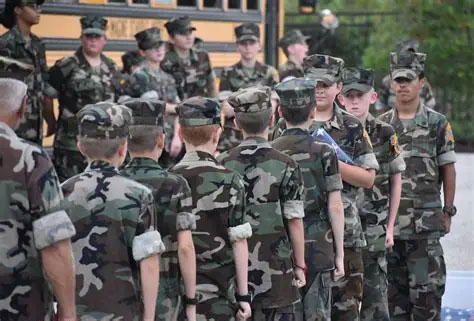
image source
Young Marines operates in a different cultural universe. Its participants often arrive with enthusiasm for Marine Corps symbolism — the uniforms, the discipline, the mythology of toughness. The program reinforces this identity through camping trips, ceremonies, marksmanship training, and a narrative of elite belonging. It is aspirational rather than compensatory.
Where JROTC fills institutional gaps, Young Marines fulfills cultural desires. It offers families a structured, patriotic youth culture that aligns with their values. The military identity formed here is elective, not imposed. It is a chosen community rather than a school‑based pipeline.
“Young Marines is not embedded in public schools; it is embedded in the cultural imagination of families who choose it.”
This voluntary nature explains its demographic profile. Programs that rely on parental initiative, transportation, and discretionary time tend to draw from families with more stability and resources. The whiteness of Young Marines is not accidental — it is produced by the socioeconomic conditions required to participate.
Two Programs, Two Racial Realities
The racial dynamics of JROTC and Young Marines reveal how militarization operates differently across class and community lines. In Black and Latino schools, military culture arrives through institutional placement. In white suburban communities, it arrives through voluntary participation. Both pathways contribute to the militarization of youth, but they do so through different mechanisms:
JROTC normalizes military authority in communities already facing structural inequities. Young Marines reinforces military identity in communities that voluntarily embrace it.
These differences matter for counter‑recruitment work. They show that militarization is not a single phenomenon but a set of overlapping strategies tailored to different populations. One strategy embeds itself in public education. The other embeds itself in community culture.
Why This Matters for Youth Activism
For youth organizers, educators, and advocates, understanding these differences is essential. Challenging JROTC requires confronting school policy, funding inequalities, and the normalization of military authority in public education. Addressing Young Marines requires engaging with community narratives, parental motivations, and the cultural appeal of Marine Corps identity.
Both are necessary for a comprehensive movement to demilitarize youth spaces. Both require strategies that recognize how race, class, and institutional power shape the experiences of young people.
“Militarization is not one story — it is many stories, unfolding differently across the country.”
By examining these programs ethnographically, we can see the deeper structures that shape youth identity and opportunity. And by naming these structures clearly, we equip young people with the tools to resist them.
Resource: Listen to the Podcast, "Militarizing Youth Minds"
###