
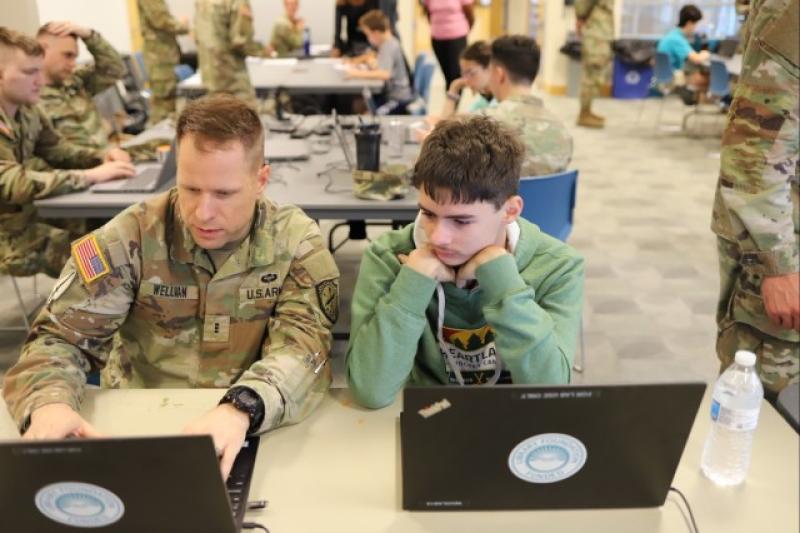

Militarization today rarely announces itself in the ways previous generations learned to recognize. It no longer arrives through the familiar figure of a recruiter stationed behind a cafeteria table, waiting to make a pitch. Instead, it slips quietly into the digital spaces young people inhabit every day. It appears in the curated ads that follow them across platforms, in STEM programs whose funding sources remain carefully obscured, in video games designed to normalize the reflexes of remote warfare, and in job postings that promise purpose and stability without ever acknowledging the machinery of violence they ultimately support. Young people now live inside a technological environment where militarization is ambient, automated, and largely invisible, and counter‑recruitment must adapt to this new terrain if it hopes to remain relevant.
Recruitment has become a data‑driven enterprise. Algorithms sort youth by socioeconomic status, gaming habits, academic interests, geographic location, and patterns of online behavior. These systems classify them as high‑aptitude, low‑opportunity, or military‑aligned, and then deliver messaging tailored precisely to those vulnerabilities. The process is not accidental; it is engineered. And because it is engineered, young people deserve to understand how their digital lives are being used to shape their futures. They deserve transparency. They deserve informed consent. They deserve the autonomy to imagine futures that do not require sacrificing their bodies, their minds, or their communities.
Militarization is no longer confined to bases or battlefields. It has woven itself into the everyday technologies that structure modern life. Artificial intelligence research feeds directly into weapons development. Cybersecurity programs lead seamlessly into intelligence agencies. Robotics labs operate with defense‑contractor funding. Gaming platforms normalize the logic of drone warfare. Even scholarships and internships marketed as opportunities for advancement often carry military obligations hidden in the fine print. Counter‑recruitment, if it is to be honest, must expand beyond the narrow question of enlistment. It must teach young people how militarism shapes the institutions they move through, the technologies they rely on, and the economic pressures they face.
Recruiters understand that young people are searching for stability and purpose, and they craft their messaging accordingly. Counter‑recruitment must offer alternatives that speak to those same needs. Civilian pathways already exist that strengthen communities rather than harm them. Climate resilience work, skilled trades, public health, education, community‑based technology, conservation, and emergency management all provide meaningful work, economic stability, and opportunities for growth. These are futures rooted in care rather than destruction, and young people deserve to see them clearly.
To reach youth effectively, organizers must meet them in the spaces where they actually live their lives. TikTok, Instagram, Discord, Twitch, gaming platforms, and AI chat environments are now central to how young people form identity, seek information, and make decisions. Counter‑recruitment cannot rely on outdated methods or assume that traditional outreach will suffice. It must speak in the language of narrative, of lived experience, of peer‑to‑peer communication. It must expose the mechanisms of algorithmic manipulation rather than simply critiquing military policy. And it must center moral agency — the belief that young people have the right and the capacity to choose futures that align with their values.
The core message of contemporary counter‑recruitment is straightforward: militarization today is technological, privatized, and largely hidden from view. Youth deserve transparency, autonomy, and meaningful civilian futures — not recruitment pipelines built from their own data. The narrative must illuminate how militarization has become digital, how recruitment operates through algorithms and gamified systems, and how young people’s online lives are being used to shape their career options. It must affirm that civilian futures are powerful and transformative, and that counter‑recruitment is part of a broader project to demilitarize technology, education, and public policy.
Visual storytelling plays an essential role in revealing what has been obscured. Imagery that uses glitch aesthetics, youth‑centered photography, and overlays of code or data streams can make visible the hidden architecture of militarization. A video that shows a military ad glitching to reveal its data‑tracking origins can disrupt the illusion of neutrality. A poster depicting a young person surrounded by algorithmic tags — STEM, gamer, low‑income, high‑aptitude — can expose the logic behind targeted recruitment. A zine page where a drone dissolves into a community garden can remind viewers that futures rooted in care are possible. These visuals help young people see the systems shaping their choices and reclaim their agency within them.
Youth counter‑recruitment in a tech age is not a defensive project. It is an empowerment project. It teaches young people how militarism hides inside technology, how their data is used to shape their futures, how economic precarity is weaponized, and how to imagine futures beyond war, surveillance, and extraction. It offers them the tools to choose differently and the pathways to build a world worth choosing.